| 일 | 월 | 화 | 수 | 목 | 금 | 토 |
|---|---|---|---|---|---|---|
| 1 | 2 | 3 | 4 | 5 | ||
| 6 | 7 | 8 | 9 | 10 | 11 | 12 |
| 13 | 14 | 15 | 16 | 17 | 18 | 19 |
| 20 | 21 | 22 | 23 | 24 | 25 | 26 |
| 27 | 28 | 29 | 30 |
- 결정적 관점
- mewemind
- The MEWEMIND Manifestation Model
- 효과성 코칭 모델
- 3S-FORM Coaching Model
- 멘탈 모델링 코칭
- 원하는 결과
- Mental Modeling Coaching
- 정신 모형
- Effectiveness Coaching
- 관점 코칭
- 현장중심 코칭심리학
- Sukjae Lee Ph.D.
- 이종서 HR 컨설턴트
- 이종서 코치
- 결정적 관점 코칭
- 결정적 관점 전환
- 효과성 코칭의 이론과 실제
- Effectiveness Coaching Model
- 미위마인드 이석재
- 효과성 프레임워크
- 코치올
- 생각 파트너 이석재
- 3S-FORM Coaching Model과 뇌과학의 결합
- Effectiveness Coaching Methodology
- 효과성 코칭 방법론
- 관점 전환
- 멘탈 모델
- 미위마인드 mewemind.com
- 효과성 코칭
- Today
- Total
미위마인드
The Concept of MEWEMIND 본문
The Concept of MEWEMIND
We need to pay close attention to the double-edged nature of perspectives such as one’s uniqueness, independence, distinctiveness, individuality, and sense of “who I am”-the ways in which we distinguish ourselves from others.
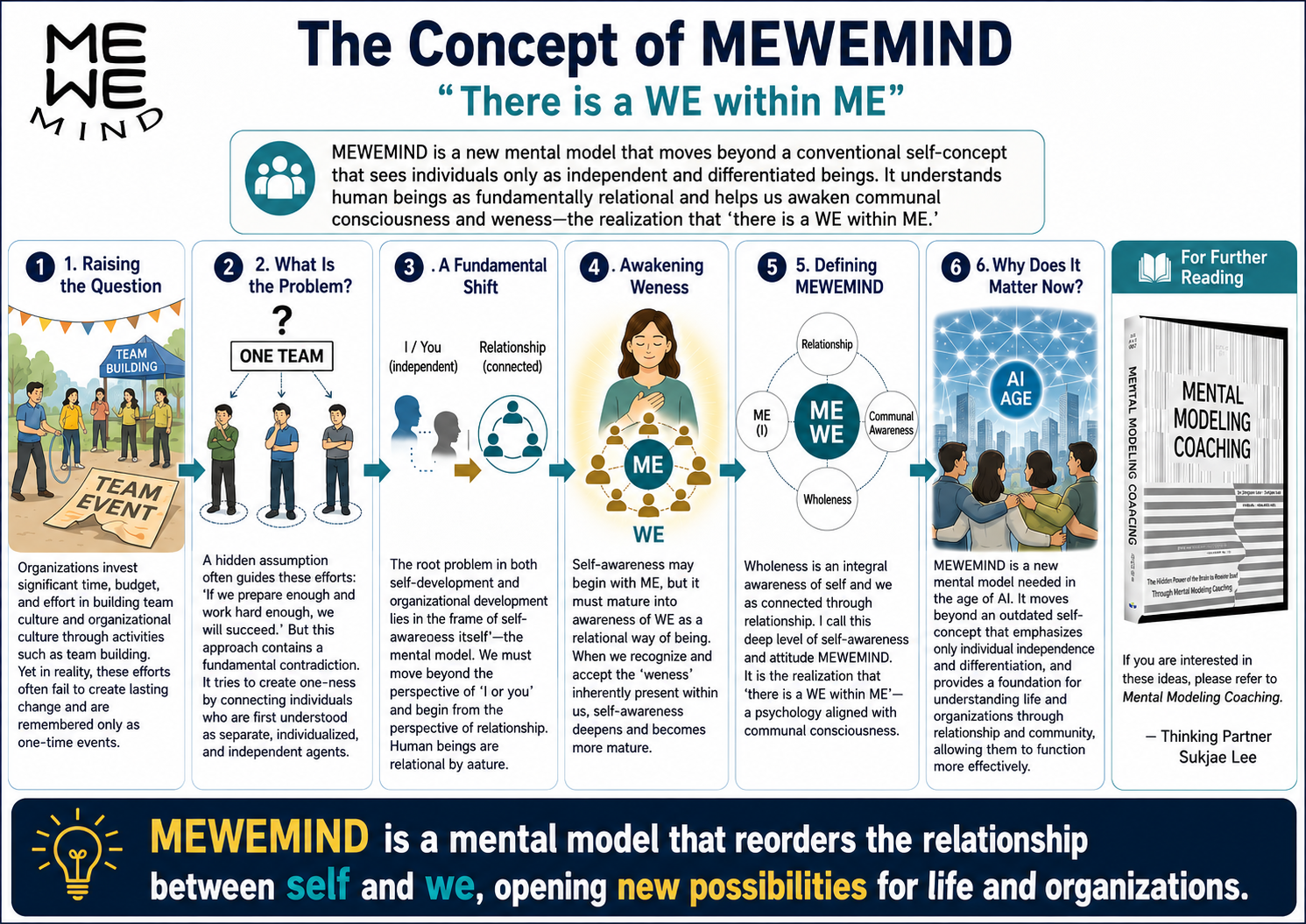
Organizations invest a great deal of time, money, and effort in building team culture and organizational culture through approaches such as team building. Yet what we repeatedly observe in reality is that these efforts often fail to take root and are easily remembered as one-time events.
What is the problem?
Behind well-designed plans and organization-wide efforts lies a basic assumption:
“If we prepare this much and make this much effort, we will succeed.”
The problem begins with the initial perspective from which we approach “oneness,” such as the idea of “One Team.”
How do individuals and organizations perceive each member of the organization?
It is a paradox to try to create oneness by connecting independent individuals who each hold a differentiated and individualized sense of self. The self-awareness of the individual-a mental model widely shared in modern society-is, by nature, mutually exclusive.
This is a fundamental problem shared by conventional approaches to both self-development and organizational development.
I believe it is now time to change the very frame of self-awareness-that is, the mental model itself.
“My inner attributes are not independent or differentiating attributes.”
Human beings are inherently relational beings. When we begin to understand the self, we should not start from the perspective of “I” or “you,” but from the perspective of “relationship.” We need to become aware of and accept the “weness” that is fundamentally embedded within us.
Self-awareness must begin with “ME” and mature into a relational awareness of “WE.”
Wholeness refers to an integrated awareness of myself and ourselves as beings connected through relationship. It is the result of self-awareness deepening from a lower level to a more mature and profound level.
I call this deeper level of self-awareness and attitude MEWEMIND.
MINDNESS is not based on the distinction between “me” and “you.” Rather, it represents a third perspective of maturity and evolution: the self-awareness that “there is a WE within me,” together with a well-aligned psychology of communal consciousness.
MEWEMIND is a new mental model needed in the age of AI.
- Thinking Partner, Dr. Lee Sukjae
출처: https://coachall.tistory.com/1638 [코치올:티스토리]
'코칭 노트' 카테고리의 다른 글
| 한 장으로 읽는 미위마인드 개념 (0) | 2026.05.08 |
|---|---|
| 미위마인드(mewemind) 개념 (0) | 2026.05.07 |
| 삶에 지친 사람들을 위한 책 (0) | 2026.05.05 |
| 미위마인드의 발견 (0) | 2026.05.04 |
| 멘탈 모델링 코칭의 관점 (0) | 2026.05.03 |


