| 일 | 월 | 화 | 수 | 목 | 금 | 토 |
|---|---|---|---|---|---|---|
| 1 | 2 | 3 | ||||
| 4 | 5 | 6 | 7 | 8 | 9 | 10 |
| 11 | 12 | 13 | 14 | 15 | 16 | 17 |
| 18 | 19 | 20 | 21 | 22 | 23 | 24 |
| 25 | 26 | 27 | 28 | 29 | 30 | 31 |
- 생각 파트너 이석재
- The MEWEMIND Manifestation Model
- 이종서 HR 컨설턴트
- 결정적 관점 코칭
- 결정적 관점
- 미위마인드 이석재
- 효과성 코칭 방법론
- mewemind
- 멘탈 모델
- Sukjae Lee Ph.D.
- Mental Modeling Coaching
- 멘탈 모델링 코칭
- 효과성 프레임워크
- 3S-FORM Coaching Model과 뇌과학의 결합
- 코치올
- 효과성 코칭
- Effectiveness Coaching
- 효과성 코칭 모델
- Effectiveness Coaching Methodology
- 관점 코칭
- 원하는 결과
- 현장중심 코칭심리학
- 관점 전환
- 이종서 코치
- 미위마인드 mewemind.com
- 3S-FORM Coaching Model
- 효과성 코칭의 이론과 실제
- Effectiveness Coaching Model
- 정신 모형
- 결정적 관점 전환
- Today
- Total
미위마인드
Developing the MEWEMIND Effectiveness Model 본문
Developing the MEWEMIND Effectiveness Model
Sukjae Lee, Ph.D.
Creator of the Effectiveness Coaching Methodology
March 8, 2026
When I first began coaching in 2002, my dream was to create and establish my own coaching theory.
Starting with leadership coaching for organizational leaders, I developed what I called the Effective Leadership Model. In order to practice evidence-based coaching, I created the Effective Leadership Assessment (ELA), a multi-rater diagnostic instrument designed to measure leadership effectiveness.
While coaching a large corporation for approximately eight years, I came to recognize an important limitation. Individual development alone was not sufficient. There was a clear need to connect individual development to team development and organizational development.
To address this need, I sequentially developed the Team Effectiveness Assessment (TEA) and the Organizational Effectiveness Assessment (OEA).
Through continuous fieldwork, I collected large amounts of practical data from real organizational settings. Based on this accumulated evidence, I began to formulate the theoretical foundation of Effectiveness Coaching, which in its early stages was known as Strengths-Based Coaching. The results of this work were later published in my book Effectiveness Coaching by a Management Psychologist (Lee, 2014).
Afterward, I continuously revised and refined the ABC Framework, which serves as the conceptual architecture of the Effectiveness Coaching methodology.
As I continued to test and validate the Effectiveness Coaching Model in real coaching environments, I explored a number of key concepts, including:
- Flow (engagement and immersion)
- Felt Sensing
- Perspective
- MEWEMIND
These explorations eventually led to additional publications.
More recently, my primary focus has been on integrating Effectiveness Coaching with neuroscience and cognitive science through a holistic approach.
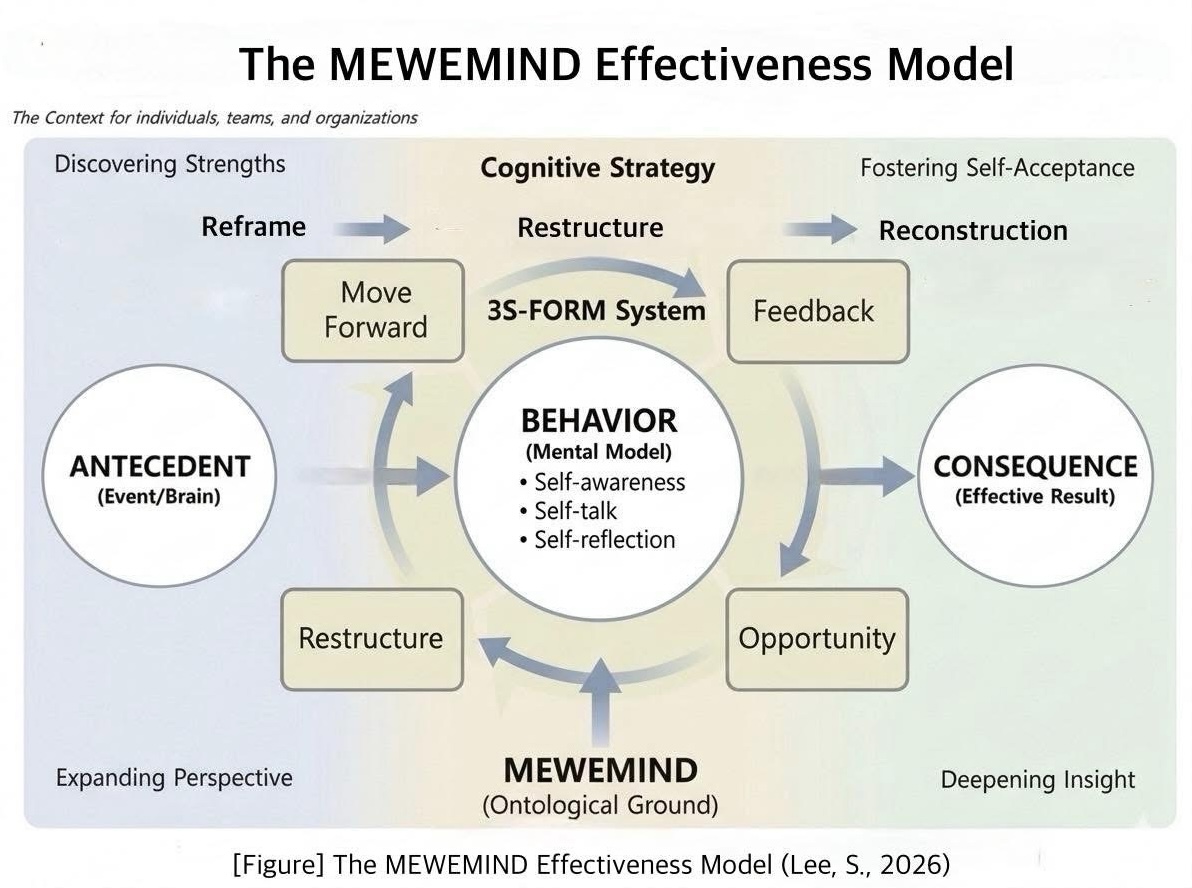
Up to March 7, 2026, I have been revising and enhancing the existing Effectiveness Coaching Model while developing several alternative model designs (Lee, 2026).
Reference
Lee, Sukjae (2026). From Intrapsychic Healing to Collective Effectiveness: Restructuring Mental Models Through the 3S–FORM Architecture. https://coachall.tistory.com/1538
'코칭 노트' 카테고리의 다른 글
| 효과성 코칭의 개발과정 (1) | 2026.03.14 |
|---|---|
| 24년의 코칭 결과 (0) | 2026.03.12 |
| 나의 꿈을 이루는 삶 (0) | 2026.03.08 |
| 들어가는 글 (0) | 2026.03.01 |
| Design and Create Your Life Proactively (0) | 2026.02.27 |


